

Part 1: Feel Like A Failure, ‘Cause I Know That I Failed You (The Worst Portrayals)
Anne Boleyn has been portrayed on film since 1911 and on television since 1952, and her popularity has only exploded since then. This isn’t surprising. Even while alive, she attracted both gushing praise and vitriolic hatred; very few people who are familiar with her story were or are neutral about her. Her life has all the elements of not just great novels, but great movies and shows: love, lust, betrayal, and death. But every depiction of Anne, especially on screen, has its own angle and story to tell. Nobody, it seems, can quite agree on who Anne was or what facets of her life and character to stress. I’ve been fascinated with Anne Boleyn since I was six years old, as detailed in my last blog post, and I’ve watched on-screen portrayals of her from around the same age. Over the last fifteen-odd years, I’ve developed very strong feelings about Anne’s on-screen depictions. Some are actively offensive. Others are so-so. But a select few are not only good but genuinely superb.
A few notes before we start: first, this is not meant to be a personal attack on the actors or writers themselves. This is purely a subjective, individual ranking of depictions of Anne in film and television. Second, I am limiting myself to fictional depictions where she has at least a noticeable speaking role. This eliminates documentaries or docudramas like Henry and Anne: The Lovers Who Changed History (2014) and depictions where she’s a glorified extra, like The Spanish Princess. Third, my placement of these depictions depends on three main factors. These are the accuracy of the writing to the events and details of Anne’s life, the quality of the actor’s performance, and how well they and the writers capture the essence of her personality and character. It is this last factor which is the most important. So join me, as I take you on a trip through twelve depictions of Anne on-screen, ranking them from my least favorite portrayal to my favorite.
#12: Charlotte Rampling in Henry VIII and His Six Wives (1972)

Charlotte Rampling’s portrayal is undoubtedly the worst that has ever been put to screen. The 1972 film was written by Ian Thorne, the writer of the Jane Seymour episode of the preceding 1970 series The Six Wives of Henry VIII, so one might have expected a more negative portrayal. However, Thorne wrote Anne’s role as if he had a grudge against her, depicting her as a frenzied, totally amoral bringer of chaos and ruin to Henry and a peaceful kingdom. To be fair, Rampling captures Anne’s style and captivating appeal, even if her temper is strangely downplayed.
That’s all the positives to her depiction, though. Her Anne has the mythical sixth finger and wart on her neck falsely attributed to her by Catholic propagandists in Elizabeth I’s reign. Given that Henry says that they are “the devil’s stigma” to Jane Seymour later in the movie, it can be safely assumed Thorne (very problematically) sought to link such conditions with evil. Moreover, this Anne is heavily implied to be guilty on all charges of adultery and incest, given her outrageous flirtations with Mark Smeaton and Henry Norris, even going so far as to sniff the sweat-soaked handkerchief she gave to the latter at the 1536 May Day joust!
Most damningly, this Anne dons blackface. Rampling’s Anne ahistorically stages the “Cardinal Wolsey going to Hell” masque five years later than history, dressing as “the Ethiop queen” in blackface and pseudo-Arabian clothing. As Anne is not recorded as having ever donned blackface, let alone for a masque she did not perform in, this adds racism to Anne’s alleged crimes in the movie, which even for a 1972 audience must have been jarring. On top of that, Rampling is never given a scene where she might evoke sympathy from the audience. Elizabeth’s birth is not depicted and barely mentioned, her January 1536 miscarriage is reported but not depicted, and she is never shown with Elizabeth. Given how much Anne loved and cared for Elizabeth in real life, such omissions when taken together are a complete travesty of the real woman. In stark contrast to Catherine Howard, whose arrest, interrogation, and execution are poignantly depicted, Anne’s last scene is at the 1536 May Day joust where she giggles incessantly and sniffs her handkerchief soaked in Norris’ sweat. This ensures that audiences have no reason to view her as anything but an amoral temptress. The movie damns Anne as a dissembling, one-dimensional harlot, completely ignoring the real Anne’s bravery, fierce devotion to her daughter and religious reform, and tragic fate.
#11: Jodhi May in The Other Boleyn Girl (2003)

The Other Boleyn Girl (2003), a 90-minute made-for-TV movie based on Philippa Gregory’s 2001 novel of the same name, was both made on the cheap and feels like it. The 2003 movie’s insistence on filming on location only highlights how little budget they had. When combined with the use of shaky cams, reality television-style confessionals, and director Philippa Lowthorpe’s reliance on four weeks of actor improvisation in lieu of an actual script, The Other Boleyn Girl (2003) is one of the worst pieces of Tudor media I’ve ever watched. But hey, I’ve come to assess Jodhi May’s portrayal of Anne, not the quality of the overall production. Surely her depiction can’t be so – what was that? Oh, she’s the only depiction of Anne to definitively commit incest on screen? Oh, brother.
While she at least has more facial expressions and vocal inflection than Natascha McElhone as Mary Boleyn, May plays Anne as the standard “wicked, ambitious schemer” stereotype. This Anne, in addition to being the only on-screen version of her to explicitly commit incest, is also the only one to my knowledge who is colder to the baby Elizabeth than Henry, who praises his daughter to the court and speaks of her with obvious affection. This is quite insulting to the real Anne. While the real Anne undoubtedly hoped her first pregnancy was a boy, there is plenty of evidence to show that she visited Elizabeth as much as her royal duties would allow her, taking great interest in her upbringing. If that was disrespectful to the real Anne’s memory, I’d argue that May’s Anne committing incest with her brother George to conceive her last pregnancy, which ended in the January 1536 miscarriage, is not only offensive but slanderous.
Anne, needless to say, is believed by nearly all scholars to be innocent of the charges she was executed for, including the incest charge. Portraying an innocent woman as guilty of the charges she was unjustly executed for, depriving her parents of two of their three children and her 2 ½ year-old daughter of a mother, is just vile. Besides, her reasoning in the movie makes no sense. She’s convinced Henry will have her executed if she doesn’t bear him a son, but why? No Queen of England had ever been executed before, and besides, not bearing the King a son wasn’t a crime! The fact that May’s Anne is guilty of incest, the only on-screen portrayal of her of whom this is unambiguously true, is enough to make her, in my opinion, the second-worst on-screen portrayal of Anne.
#10: Natalie Portman in The Other Boleyn Girl (2008)
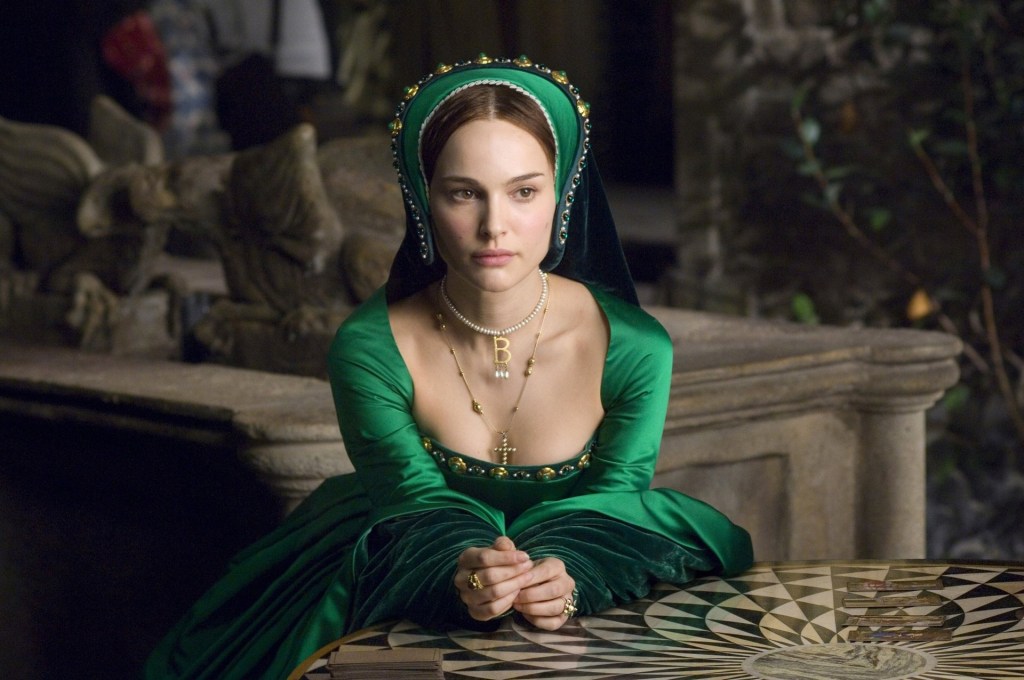
Natalie Portman looks and (mostly) dresses the part, just like Charlotte Rampling in the 1972 film, and to be fair, she also gets across how witty and captivating the real Anne was. Unfortunately, it all goes to hell once she starts speaking. Even moving past her painful attempt at an English accent, The Other Boleyn Girl (2008) gets countless facets of Anne’s character and life blindingly wrong to the extent that one wonders why they didn’t just make a fantasy movie. Anne is shown setting out to seduce the King to “steal” him from her sister Mary, who is pregnant with his child. She even goes as far as to force the lustful, weak-willed Henry to never speak with her sister again, despite the fact she’s just given birth to his son in the next room! Needless to say, in real life, Henry was the one who pursued Anne, not vice versa, and he’d never have been this weak-willed.
But worse is yet to come. Furious that Anne hasn’t slept with him yet, an enraged Henry rapes her, resulting in her becoming pregnant with the future Elizabeth I. This wasn’t in the novel, and the movie’s scriptwriter, Peter Morgan, copied this from an earlier production of his, the 2003 ITV two-parter Henry VIII. He justified that production’s rape scene by arguing that it showed Henry’s brutality, as if we couldn’t tell from the fact he beheaded two of his six wives, one being Anne! Morgan’s gratuitous use of rape in this movie is equally abhorrent. Henry was guilty of many things and abusive in many ways, but there is no evidence of this ever happening, let alone of him raping or sexually assaulting anyone.
Even worse, Portman portrays Anne as almost going through with committing incest with George to fool Henry into thinking she hasn’t miscarried the January 1536 pregnancy, only losing her nerve when they’re both about to begin in their nightclothes. In addition to this plan’s logical/temporal incoherence and stupidity, this almost-incest is nearly as slanderous as Anne’s actual incest in Jodhi May’s portrayal, for the same reasons. It is so blindingly offensive to the real Anne, who was falsely condemned and executed on these charges in a gross miscarriage of justice, that it boggles belief. Equally egregiously, Anne is shown sobbing and breaking down on the scaffold once she realizes Henry won’t pardon her. The historical Anne had little left at her death. Her family had left her, either through abandonment, estrangement, or death, her marriage had been annulled, and her daughter Elizabeth had been declared a bastard. What she did have in spades was dignity and courage, something remarked on by nearly every account of her execution. Taking that away is incredibly disrespectful and earns Portman’s Anne the number ten spot here.
#9: Barbara Kellerman in Henry VIII (1979)

It’s not quite the director’s fault that this Anne is so meek, frankly verging on a silent non-entity. Henry VIII (1979) was a television adaptation of the 1613 history play of the same name, jointly written by William Shakespeare and John Fletcher a decade into the reign of James I. Henry VIII is not a good play. It’s far more focused on a political cycle of rises and falls than creating a work whose plot and characterization are as richly drawn as its language. In dealing with events less than a century old and seeking to not make Catherine of Aragon, Henry, or Anne into a villain, both playwrights take much of the bite out of the latter two. One would hardly know from the play that England broke with Rome at all, let alone faced papal opposition. Anne’s beheading is not depicted or mentioned, as the play ends with the glorious and triumphant baptism of the future Elizabeth I.
While Catherine is depicted as a majestic and eminently sympathetic figure, Shakespeare and Fletcher do not dig into Henry’s rich emotional state and mind, let alone Anne’s. In fact, Anne speaks only in two scenes! Her only major scene is Act 2, Scene 3, where she expresses great pity and sympathy for Catherine, declares she “would not be a queen for all the world”, but accepts the title of Marchioness of Pembroke from Henry. It’s a bloodless portrayal, one which makes her into an almost biblical handmaiden and paragon of maidenly modesty and signally fails to convey the real Anne’s wit, charm, or bold spirit.
Kellerman performs Anne probably exactly how Shakespeare and Fletcher wanted her to be acted. I’m not sure, to be honest, whether this is a positive. She depicts Anne as a soft, blushing ingenue who is never shown to exert any agency of her own. As Shakespeare and Fletcher intended, she is always acted upon; Henry falls for her, marries her, crowns her, and Elizabeth is born from her. Perhaps the least negative thing that can be said about this depiction is that it’s not as offensive as the bottom three portrayals. When juxtaposed with the Annes of Portman, May, and Rampling, who are all at least partly guilty of the crimes the historical Anne was innocent of, Kellerman’s Anne’s shyness pales in seriousness. That’s all for now. Join me soon for part 2: the “meh” portrayals of Anne! Let me know your thoughts in the comments.
 Adventures in Early Modernity
Leave a comment