
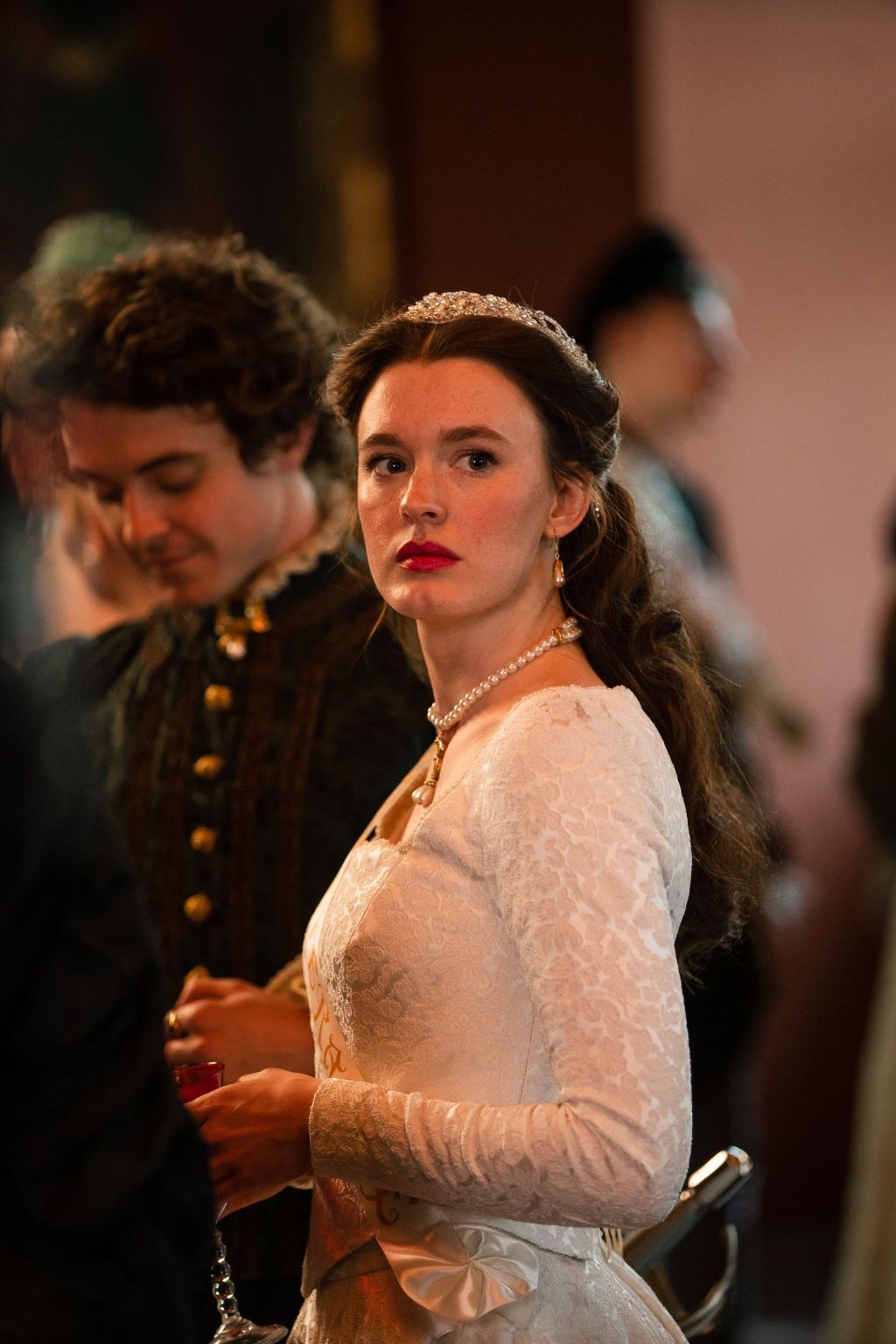
Part 2: It’s Fine, It’s Cool (The OK Portrayals)
Thankfully for my sanity, we’ve gotten out of the truly terrible on-screen Anne Boleyn portrayals. OK, so these next four aren’t the best, in my opinion, but they’re fine. They’re not always actively offensive. Some of them even have significant redeeming qualities! But we’re not in the realm of great Anne depictions yet. So without further ado, here are #8-5! As with last time, this is a subjective ranking, not a personal attack.
#8: Merle Oberon in The Private Life of Henry VIII (1933)
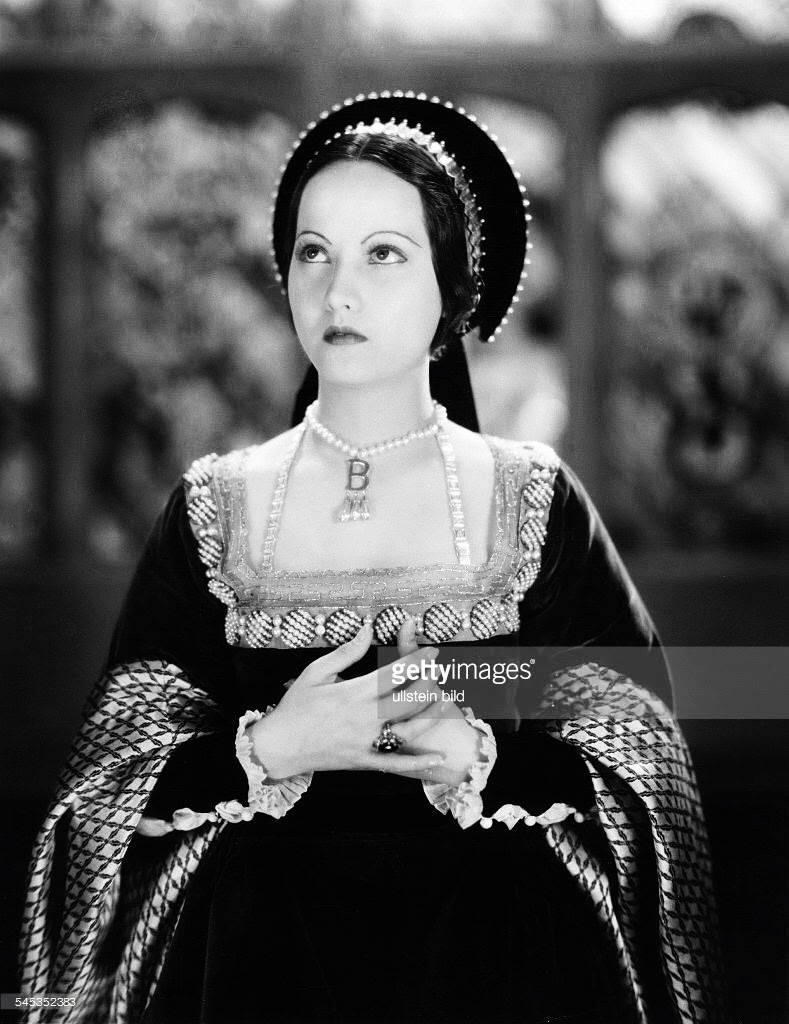
At just 22 when she played Anne, who was anywhere from 29 to 35 at her death, Merle Oberon is, to my knowledge, the youngest actress to ever play an adult Anne. Unfortunately, she had to do so in The Private Life of Henry VIII (1933), directed by Alexander Korda. Although ostensibly a “comedy/drama” according to Google, Charles Laughton’s jarringly comedic performance as Henry and the astonishingly brazen liberties with historical events, chronology, and characterization make for a movie that neither gripped me nor made me laugh.
Despite being executed sixteen minutes into the movie, which begins the day of her execution, I still liked Oberon’s portrayal slightly more than Kellerman’s. This is mainly because, while Oberon’s Anne is understandably sad yet resigned in her few scenes, you can tell that she used to be a more vibrant woman before the movie began. Henry himself refers to Anne as “ambitious” and juxtaposes her alongside the “stupid woman” he will marry, Jane Seymour. While unfair to Jane, this at least recognizes Anne as an independent actor. With a soft, wistful voice, she quips, “Isn’t it a pity to lose a head like this? Still, they will easily find a nickname for me among the queens of England – I shall be ‘Anne sans tete’. That means, ‘Anne who lost her head.’” Oberon’s Anne remarks on her “little neck”, as in history, although she phrases it as a question, asking Kingston, “And I have such a little neck, haven’t I?” as she smiles, her eyes misty with tears. If Oberon has little to do with her role as Anne other than stand around, look beautiful, and gaze into the middle distance with eyes full of melancholy, she at least leaves a lasting impression on the viewer, which is more than can be said of Kellerman’s Anne.
Her ladies, furthermore, all assume her innocence. Unfortunately, the film’s uneasy mixture of farce and serious drama explodes to the surface in its treatment of Anne’s death. Anne’s preparations for death are intercut with scenes of ladies-in-waiting (including an ahistorically adult Catherine Howard, already at court) bantering, joking that the cannon that will announce Anne’s death is “a pretty arrangement. The joint comes out and bang, the sweets come in!” Even more incongruously, Anne’s death is seen from the perspective of a bickering married couple, who argue about the wife not having had a new gown for a year immediately after Oberon’s Anne is beheaded. The fictional husband’s retort that his wife will have a new one for her execution is not only distasteful but greatly reduces the impact of Oberon’s Anne on the viewer. Presumably Korda feared that taking Anne’s death seriously would turn audiences against the movie’s title protagonist. It’s a shame, as I think Oberon could’ve delivered a better performance given a better script. As it stands, though, she ends up at #8.
#7: Helena Bonham Carter in Henry VIII (2003)

I genuinely don’t think I enjoyed any part of this ITV two-parter. The best I can say about any facet of this production, from the cinematography to the writing to the acting is that I didn’t actively wince or recoil at times. The costumes were nearly all inaccurate, and most of the time, not pretty either. The plot seems to have been written by someone who skimmed what Encyclopedia Britannica and a popular history book on the matter had to say about Henry’s reign and wives before suffering a severe concussion and jumbling all the details. Ray Winstone was far too brutish and physically violent as Henry, and five of his wives are written by writer Peter Morgan in rather one-dimensional terms. This leaves Anne Boleyn as the only particularly complex wife, even if she’s only present in the first part, which ends with her execution. She changes from a witty spitfire who spurns Henry’s advances to an abused and weary wife. Unfortunately, Helena Bonham Carter gives the impression of having been affected by the low quality of every facet of this production. As such, she gave an aggressively bland performance as Anne. Morgan clearly wanted her to be witty, fiery, beguiling, distraught, yet ultimately dignified, but Bonham Carter fails to convey any of these aspects except for Anne’s verbal lashings. In the scenes where she argues with people, Bonham Carter captures the real Anne’s boldness and short temper.
Alas, such flashes of life are brief, and in nearly every other scene, Bonham Carter signally fails to bring any passion to her role. Strong emotions desert her, whether when supposedly falling for Henry, saying her final goodbyes to Elizabeth, or even delivering her execution speech! As in The Other Boleyn Girl (2008), Peter Morgan depicts Henry as raping Anne as a reaction to her anger at his affairs, resulting in her becoming pregnant but shortly afterward miscarrying. As stated in the last post, it’s a lazy and exploitative shorthand to signify Henry’s a monster instead of trusting the viewer to understand it from everything else. Bonham Carter’s Anne, at the least, is spared a weeping fit on the scaffold and dies with dignity. Unfortunately, this tragic moment is shattered by an incredibly gratuitous and tasteless shot of the swordsman holding up her severed head. I don’t know why in God’s name they did this. It’s turning the violent death of an innocent woman by her husband into a shot from a snuff film, milking it for all possible shock value. The only reason Bonham Carter’s Anne ranks this high is because she has a significant character arc that gives her agency and (tries) to give her spirit, and she is correctly shown as innocent of all charges.
#6: Amy James-Kelly in Blood, Sex & Royalty (2022)
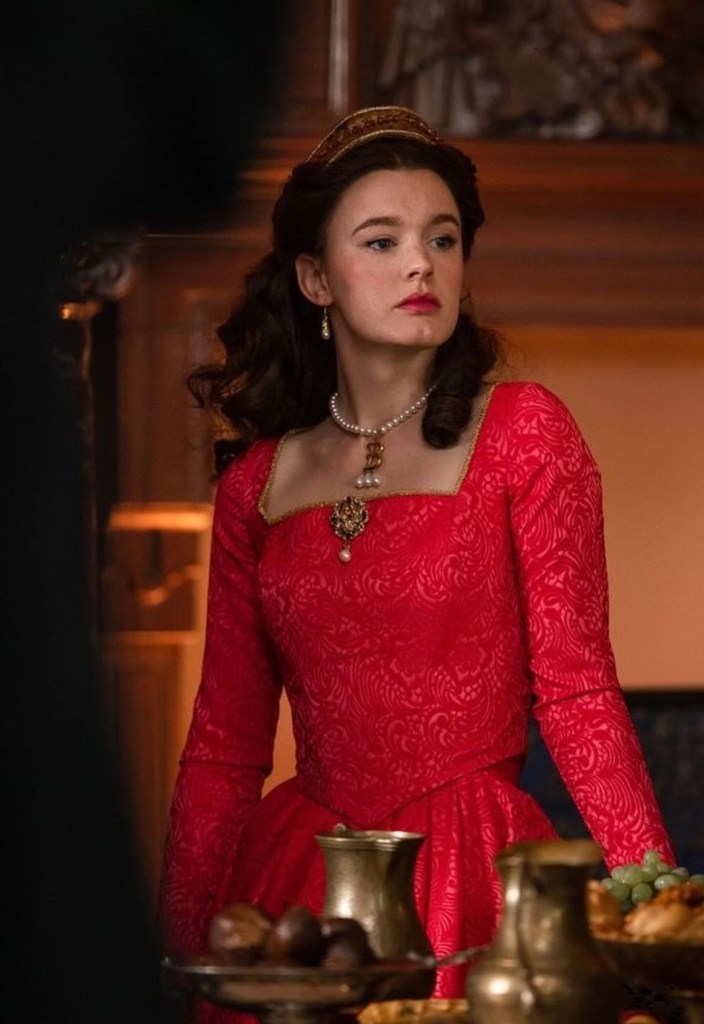
I really wanted to like this portrayal more. For days before publishing this, I wrestled with whether to put this above or below Claire Foy’s depiction of Anne in Wolf Hall. After all, as detailed below, I have significant problems with how Anne was portrayed and written in that show. Unfortunately, when I watched it again for this post, I almost immediately remembered each of the many downsides of this production. I was reasonably fine with how Henry and Anne’s relationship was written. I especially liked how Anne’s rejection of Henry’s offer to make her his mistress was portrayed not just as a desire to protect her reputation and honor, but born out of deep hurt that he’d say such a thing if he professes to love her. Like in real life, BSR’s Anne has an intense and loving relationship with Henry. Admittedly, it sours probably more intensely after Elizabeth’s birth than in history. Still, as with the best Anne portrayals, James-Kelly also conveys Anne’s wit, courage, hot temper, and love for Elizabeth. Above all, she refreshingly captures the historical Anne’s fervent evangelical faith and charitable side, as she accurately fights with Cromwell over the allocation of monastic funds. I want to note its positives first, as well as the excellent contributions of Tudor historians like Dr. Tracy Borman OBE, Dr. Owen Emmerson, Professor Suzannah Lipscomb, and several others. They did a superb job, and what follows is not an attack on them! My criticisms below of this program only deal with its dramatic segments.
Unfortunately, nearly all other aspects of BSR’s Anne, as well as BSR itself, are a mess. Aside from the inaccurate costumes (acceeptable in fiction in my opinion, but not with a docudrama), BSR never truly captured the ethos of Henry VIII’s court. In part, this is because I found it harder than with any other portrayal in this series to believe that the cast, including James-Kelly’s Anne, were actually sixteenth-century royalty and nobility. Save for a few, the cast mostly performs their roles as if in an irreverent period drama like The Great. Neither James-Kelly’s Anne nor Max Parker’s Henry truly had the courtly polish and royal gravitas that their real figures possessed in spades. When they argue, it feels like watching a Channel 4 soap opera inexplicably costumed in Renaissance Fair attire, rather than a clash between a sixteenth-century royal married couple.
Above all, this depiction is severely hamstrung by the lines the actors were tasked with reading. There’s lines like “Cardinal Wolsey, King Henry’s work wife and court super snitcher.” “You’re looking regal, sis!” And, of course, Anne’s classic remark at her trial for adultery, incest, and treason: “This is insane!” How am I supposed to take this portrayal seriously when it barely commits to having its performances and dialogue seem sixteenth-century? It’s a real testament to the writers’ reasonably fine portrayal of the historical Anne that it’s number six. Unfortunately, no portrayal of Anne which ever has her say, “Some were Team Katherine, others were Team Anne” with a straight face is ever going to make it into my top five.
#5: Claire Foy in Wolf Hall (2015)

I really struggled on where to place Claire Foy’s portrayal, given that its portrayal of Anne is filtered through one character’s perspective. Both the novels and show are brilliant and superb pieces of historical fiction.. However, I would argue that both the books and show portray Thomas Cromwell overly sympathetically, and, in the process, rather vilify Anne. The show, just like the books, depicts her as often thoroughly unpleasant. This isn’t necessarily a problem. Diarmaid MacCulloch’s biography of Cromwell established that Anne and Cromwell were far less friendly prior to 1536 than previously assumed, so it makes sense that a series from his perspective would see her in unfavorable terms. But the series adds, changes, and omits historical quotes and events, meaning that the dislike of many viewers for Anne owes largely due to the show’s lopsided portrayal of Anne, rather than the actual history. It is thus difficult to wholeheartedly accept that Anne’s depiction is unsympathetic just because it’s from Cromwell’s viewpoint. For instance, while Anne is recorded as having threatened to kill her stepdaughter Mary in fearful rants, there is no evidence that she cold-bloodedly asked Cromwell or his men to seduce Mary to ruin her reputation.
The ahistorical omissions in Anne’s portrayal, too, are equally loud. The show leaves it unclear whether Foy’s Anne is guilty or innocent on the charges of adultery, treason, and incest. When Cromwell confronts her in the Tower, Foy’s Anne is proud yet terrified but is strangely not shown or mentioned declaring her innocence or swearing it on the Eucharist. Most infuriatingly, her spirited, eloquent defense at her trial, which was remarked on and praised even by hostile sources like the letters of the Imperial Ambassador Eustace Chapuys, is reduced to Anne just pleading “No” to every charge but one (giving money to Francis Weston) that she’s accused of. Given the ample contemporary evidence for her constant swearing of her innocence, it is difficult to view the show’s omissions as anything but a desire to make Anne’s guilt more ambiguous than in history to make audiences more sympathetic to Cromwell.
Still, I appreciate Foy’s depiction of Anne as a keenly intelligent political player, and she conveys a real sense of the real Anne’s great love for Elizabeth. As in history, Foy’s Anne has courage and “a spirit worthy of a crown”. Furthermore, her increasing unraveling and panic from Episode Four onwards is a masterclass in subtle acting. The high quality of her performance on its own terms, as well as the fact that at least Foy’s Anne behaves like a sixteenth-century queen, pushes it above Amy James-Kelly’s portrayal. The fact she’s not clearly guilty or the subject of gratuitous sexual violence also counts for something. But the ahistorical negative additions that Wolf Hall makes, as well as its disingenuous obfuscation over whether Anne is innocent or not, unfortunately make it impossible for me to justify any higher placement. I recognize this will be a controversial take, so let me know your thoughts in the comments. Until next time, when we’ll look at the top four portrayals of Anne on screen!
 Adventures in Early Modernity
Leave a comment