
Part 1: “A gullible sex addict in wacky shoulder pads” (The Awful Portrayals)
GENERAL CW/TW: MENTIONS AND DISCUSSIONS OF DOMESTIC ABUSE, RAPE, ATTEMPTED RAPE/SEXUAL ASSAULT, AND MURDER
When he died in 1547, in the midst of a cold January night, Henry VIII became part of a select group of historical figures whose reputations and legacies were, and still are, endlessly contested. It was thus natural that with the birth of cinema, followed by the beginnings of television drama, Henry would become the star of plenty of films and television programs. His six marriages, beheading of two of his ill-treated queens, and break with the Roman Catholic Church all but guaranteed him a permanent place on screen. As with his second wife, the iconic and controversial Anne Boleyn (about whom I’ve already published another three-part series of blog posts ranking her on-screen portrayals), very few people who are familiar with Henry’s story are neutral about him. Unlike Anne, nearly everyone I’ve met hates Henry, and for good reason. But if historians, writers, and the general public alike seem to all agree that, at least on a personal and human level, Henry VIII was ultimately a horrible monster, the first two groups otherwise disagree surprisingly frequently on how to interpret him.
I’ve been morbidly fascinated by Henry since I was a small child, and I’ve watched countless on-screen depictions of the former. A few months ago, before starting my DPhil at Oxford, I rewatched twelve of these. This is, of course, ultimately a subjective ranking of Henry’s depictions in film and television, and while I limit myself to his fictional, English-language depictions in those media, many more actors have portrayed Henry on screen than I’ve included here. I have aimed to cover his main depictions in terms of fame, but this is not an exhaustive list. Nor is this a personal attack on the actors or writers themselves. As with my Anne rankings, my placement of Henry depictions depends on three factors: historical accuracy, the quality of the actor’s performance, and how well they and the writers have captured the essence of the king’s personality and character. As before, it’s the last of these that’s the most important to me. So let’s embark on a cinematic royal progress far more extensive than any Henry himself embarked on, ranking them from my least favorite portrayal to my favorite!
N.B. The quote in the subheading comes from Alex von Tunzelmann’s August 6, 2008 review of The Other Boleyn Girl (2008) in The Guardian.
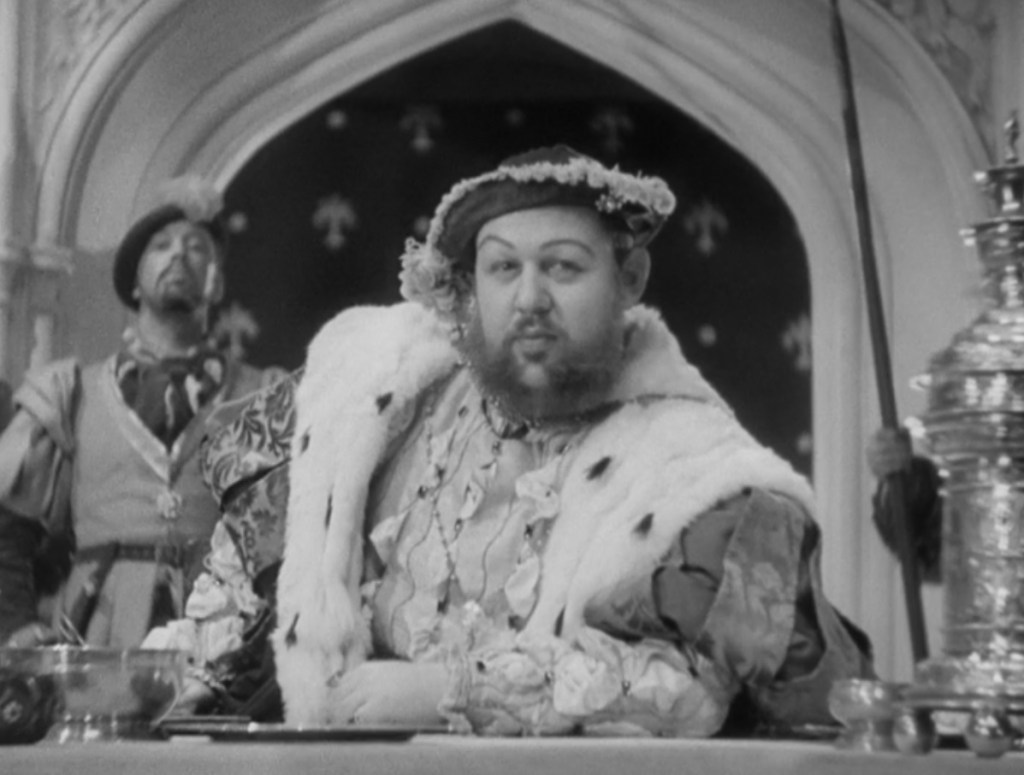
#12: Charles Laughton in The Private Life of Henry VIII (1933)
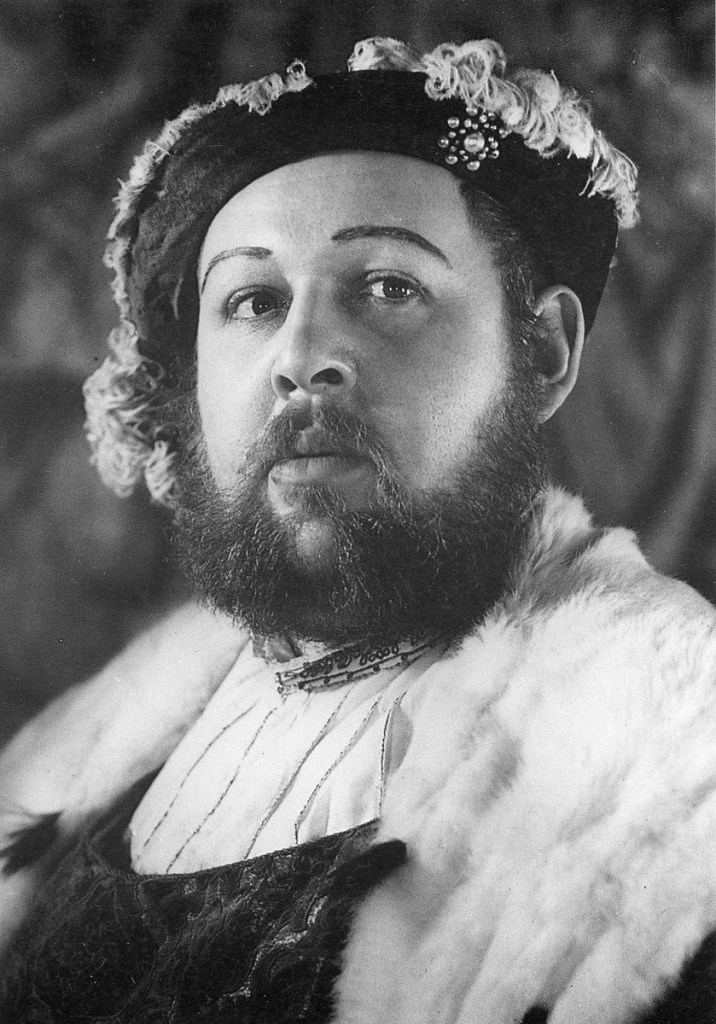
In 1933, Charles Laughton managed to become both the first major depiction of Henry VIII in a sound film and also, to date, the absolute worst on-screen portrayal I’ve seen of Henry ever. And he somehow won an Oscar for Best Actor while doing it; the standards must’ve been lower back then. (Much of my review of Laughton’s portrayal below has been influenced by Professor Greg Walker’s insightful 2003 analysis of The Private Life, published with I.B. Tauris.)
The Private Life’s director, Alexander Korda, made the bold decision to both start his film on May 19, 1536, the day of Anne Boleyn’s (Merle Oberon) execution, and to also play it for laughs. Henry first enters the film to flirt with Catherine Howard (Binnie Barnes, inaccurately a grown woman to the historical Catherine’s 13-14 in 1536), walking with his legs akimbo and hands on his hips like the Holbein portrait. This does not bode well for the rest of the movie. He laughingly advises Thomas Culpeper to “marry a woman like my sweet little Jane; marry a stupid woman!” and all but drags Jane Seymour (Wendy Barrie), a 21-year-old who has all the smarts of a five-year-old in this version, to the altar. Indeed, Laughton rarely makes it through a scene without issuing a hearty guffaw, which eventually makes him seem more mentally unbalanced than anything. Once Jane dies after giving birth to Prince Edward off-screen, this Henry is cast as a hapless, sexually unmanned fool at the mercy of seemingly every woman in his court. The wily Anne of Cleves (Elsa Lanchester) wins her freedom from an undesired match with Henry (and the freedom to be with her fictional lover) through ugly expressions and a wedding-night card game, the ambitious Catherine Howard shuts him out of her bedroom and, after marriage, makes out with Culpeper while he’s sleeping only six feet away, and Catherine Parr (Everley Gregg) scolds him at length like a disappointed mother.
It shouldn’t have to be pointed out that any king who broke with the papacy, married six times, and beheaded two of his wives was hardly likely to be as bumbling as Laughton, nor indeed as shy with women. Henry would not have had to resort to tiptoeing through the palace corridors at night for a pre-Anne of Cleves rendezvous with Catherine Howard, and nor would he have ever stood for the latter shouting at him to “Get out of my room!” Nobody would’ve feared the historical king if he were this much of a buffoon. Yet it’s impossible to dismiss Laughton’s portrayal as simply a comic take on Henry – plenty of scenes in this movie are played for drama, such as a teary-eyed Anne Boleyn quipping that she has a little neck. The fundamental problem with Laughton’s portrayal is not only that his Henry rarely exhibits any authority whatsoever, but that trying to make him into a lovable, childlike oaf problematically whitewashes the monstrous, wife-killing tyrant he historically was. It’s beyond inaccurate; it’s downright grotesque.
#11: Ray Winstone in Henry VIII (2003)

CW/TW: mentions and discussions of domestic abuse and rape
It’s one of the first things anyone who does remember this obscure 2003 ITV two-parter brings up, but to be honest, while it doesn’t fit my mental image of Henry VIII, I’m not implacably opposed to Ray Winstone having a Cockney accent in this. Technically speaking, Henry’s Early Modern English would’ve sounded quite different from literally every portrayal of him now, particularly pronunciation-wise. Winstone also looks somewhat like Henry, at least from his marriage to Anne Boleyn (Helena Bonham Carter!) onwards. Those are all the not-entirely negative things I can say about this portrayal; the rest? Oh boy.
The ITV executive who commissioned Henry VIII (2003) told The Independent at the time that it was “partly inspired by The Sopranos. The idea of the ‘gangster king’ very much informs the piece.” Needless to say, this fundamentally misunderstands the nature of 1500s kingship! Winstone, to his credit, makes for a charismatic and magnetic figure, but as the executive intended, he’s more akin to Tony Soprano than the brutal, yet cultured and pious Henry of history. Indeed, there’s very little sign of the latter two qualities in this portrayal, and it’s difficult to believe this Henry could compose music, let alone engage in sophisticated theological arguments with Protestants like Martin Luther.
What’s absolutely unforgivable, though, is Winstone’s portrayal of Henry as both sexually and physically violent towards his wives. Despite its chronological impossibility in real life, he screams at and throws a heavily pregnant Jane Seymour (Emilia Fox) to the ground when she berates him for recently reneging on his promise to spare Robert Aske, which causes her to go into labor, ultimately killing her. When he finds out about Catherine Howard’s (Emily Blunt!) infidelity, he goes berserk, ahistorically pulling a knife on Catherine and threatening to kill her there and then. And when he’s infuriated with Anne Boleyn yelling at him over his affairs, he rapes her, causing her final, doomed 1536 pregnancy. This rape scene proved too much for viewers when it aired, who complained, as well as historians, who rightly pointed out that no evidence exists of Henry being sexually violent or physically violent to his wives, save for beheading two of them. To be sure, Henry was awful, violent, and abusive towards his wives. But there are many types of abuse, and men can and have been domestic abusers without ever laying a hand on their victims. Inaccurately depicting Henry VIII as a wife-beater and marital rapist not only dangerously glosses over the similar reality faced by many victims today, but is also frankly vile. I see no reason to insert rape or sexual violence into a fictional depiction of real women who were already abysmally treated by their husband, given that there’s no evidence for or indication of it! Henry’s wives suffered enough in life; what does it say about ITV or Peter Morgan that they wanted to see them subjected to additional violence at the hands of Winstone’s Henry?
#10: Eric Bana in The Other Boleyn Girl (2008)

CW/TW: mentions and discussions of rape
At least there was something perversely magnetic about Ray Winstone’s portrayal of Henry VIII as a modern mobster. Eric Bana’s Henry, despite being more conventionally handsome than Winstone’s, is also a far shallower character. Bana’s Henry is, for lack of a better word, cardboard. There is no depth to this Henry, no semblance of an inner life or emotions. Apparently, before this movie was released, it had Oscar buzz; among other things, Bana’s lifeless performance surely helped put an end to this. While the script (written once more by Peter Morgan!) does have all the accuracy and logic of a ChatGPT hallucination, much of the blame for the gaping void that is this depiction of Henry must surely lie with Bana himself.
When on a trip to the Boleyn family home, Anne (Natalie Portman, struggling with the accent) and Mary Boleyn’s (Scarlett Johansson, struggling with emoting) father and uncle plot to pimp out the former to Henry, but he ends up falling in love with Mary instead. It is repeatedly declared by himself, Mary, Anne, and everyone else that Henry has fallen in love with Mary, but not only does Bana’s wooden performance give little indication he feels anything towards her, but there’s also zero emotional/dramatic build-up to this. But when Anne returns from her ahistorical months-long (!) “exile” to the French court, Henry proves incredibly fickle and falls for Anne so hard that, on her orders, he promises to never speak to Mary again. And he promises this even after, in the next room over, Mary gives birth to their illegitimate son! The break with Rome is glossed over to an unbelievable extent, and again, Peter Morgan proves himself a lazy writer, cheaply using rape for drama and shock value when Bana’s Henry, in a fit of rage that Anne hasn’t yet slept with him, rapes her, causing her to fall pregnant with … Elizabeth I. It’s frankly just as disgusting as when he made Winstone’s Henry do the same, and my comments on that depiction apply here as well. Given how vacant Bana’s acting has been up to now in the movie, it thus comes as a shock when he later not only has Anne and George arrested for incest, but also tricks Mary into thinking Anne will be spared. Of course, he then sends a message that essentially says, “Haha, sucker!” to Mary at the execution, but it’s still surprising that this version of Henry was able to plan that far ahead.
Although Winstone’s version of Henry was perversely magnetic and had a bit more interiority, Bana scores a bit higher in this ranking. Bana’s vacant acting was at least slightly more believable as a sixteenth-century Tudor king than Winstone’s overly sleazy and savage ruffian; he looked more at home at a court ball, for one. And equally importantly, while still equally awful, it’s a minute comfort that viewers are not subjected to as many cheap and exploitative scenes of royal domestic violence by Eric Bana’s Henry.
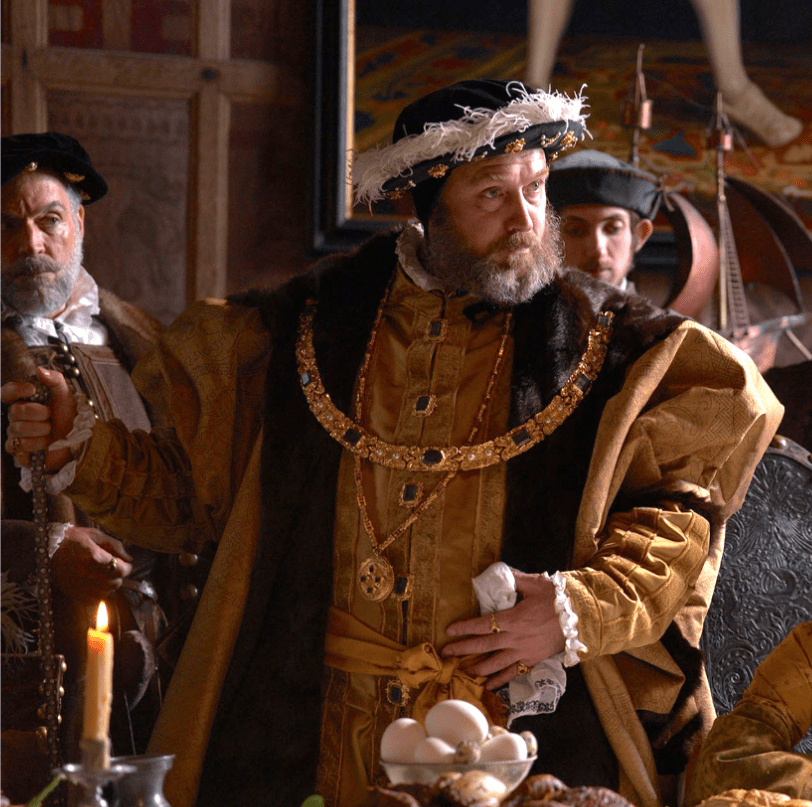
#9: Jude Law in Firebrand (2023)
CW/TW: mentions and discussions of attempted sexual assault, domestic abuse, and murder
Now, this might be unexpected for those of you who remember the hype for this movie. Surely placing Jude Law’s depiction this low, when his costumes and appearance as the old Henry are so on point, has to be a mistake! And yet, it’s true – this movie, and above all, Jude Law’s Henry, fall far short of the high expectations many had for it.
Despite being based on the novel Queen’s Gambit by Elizabeth Fremantle, Firebrand deviates significantly from both the novel’s plot and actual history. At the start, Catherine Parr (Alicia Vikander, best known for playing Lara Croft in Tomb Raider) is forced to manage an England on the edge while Henry’s away in France. And then he returns. On the outside, Jude Law’s Henry is perfect. He nails Henry’s sorrow at aging, the real Henry’s egotism, self-centered yet traditional piety, and above all, his terrifying charisma. When he leads the entire court in an impromptu recital of Pastime with Good Company, it’s both hard to look away from the king and also just as clear that anyone who stops singing might be headed to the scaffold. For good measure, the audience is also subjected to horrible shots of Henry’s rotting leg ulcer, along with very uncomfortable sex scenes. However, when he has the Protestant preacher Anne Askew burned alive, and Catherine tells him “her death is on your soul”, Law’s Henry grabs her by the neck. In private later, Henry makes her pray in Latin while sticking fingers in her mouth, in a really revolting effort to try and claim her. Catherine (fictionally) falls pregnant by Henry, but after getting blindly jealous of her and Thomas Seymour at a festival, he privately screams at her accusations that she’s committed adultery. Then, horribly, despite her earlier statement that “He has never laid a finger on me”, he tries to rape her, only for Catherine to stop him in the nick of time by wounding his leg. I don’t think I need to repeat my earlier comments in Winstone and Bana’s sections about why I find such ahistorical insertions of sexual violence and domestic abuse both unnecessary and troubling!
In short order, Catherine somehow survives this but miscarries, Henry wakes from his delirium and then has Catherine (completely fictionally!) arrested and thrown in a dungeon, and then inexplicably summons her back to see him alone the day she’s to be burned. Naturally, Catherine strangles him to death. This did not happen, and Elizabeth’s comment that “It was in no one’s interests to question what had happened” is impossible for any thinking viewer to take seriously given the events of the last two hours! Law definitely captured Henry’s decay into a tyrannical monster. But he overshot the mark and made him into a brutish ogre, much like Ray Winstone did 21 years before. He might have played the part better, but his sleaziness, the unnecessary sexual violence, and above all, the absolutely wild “Catherine Parr strangles Henry to death” twist ending force me to rank Firebrand’s portrayal of Henry at the bottom tier of my list.
Well, that’s it for now. Let me know your thoughts in the comments below, and join me soon for part 2: the mediocre to simply middling on-screen depictions of Henry VIII!
 Adventures in Early Modernity
Leave a comment