
Part 2: Hollow Crowns and Hollow Kings (At Last, the Meh Portrayals)
Well, I’ve returned to this blog at last. I’ll save a detailed explanation for why I haven’t posted since last year for after this part of my Henry VIII ranking (and the final part) are both published, but suffice it to say that it wasn’t due to a lack of desire to do so. I had often thought during the second and third trimesters of the first year of my Oxford DPhil about writing some more on this blog in the little spare time I had from my research. However, I wasn’t too sure whether A) anyone was actually reading these blog posts and B) whether anyone was interested in them. Having been convinced that there is, in fact, an audience for this blog, I’m going to revitalize it and pump new life into it, not least by expanding the historical topics I’ll be discussing and by creating a new Instagram account to promote it. Look out for (among other things) posts on books I’m reading, meditations on what it’s really like as a History DPhil student at Oxford, and whatever historical miscellanea fascinate me! Without further ado, then, here’s part two of my ranking of on-screen Henry VIII depictions, based on the same criteria as part one: this time, we’re looking at the ones that are merely mediocre or average. As with the previous post, this is my own subjective ranking, not an attack on any of these actors.
#8: Mark Stanley in Anne Boleyn (2021)
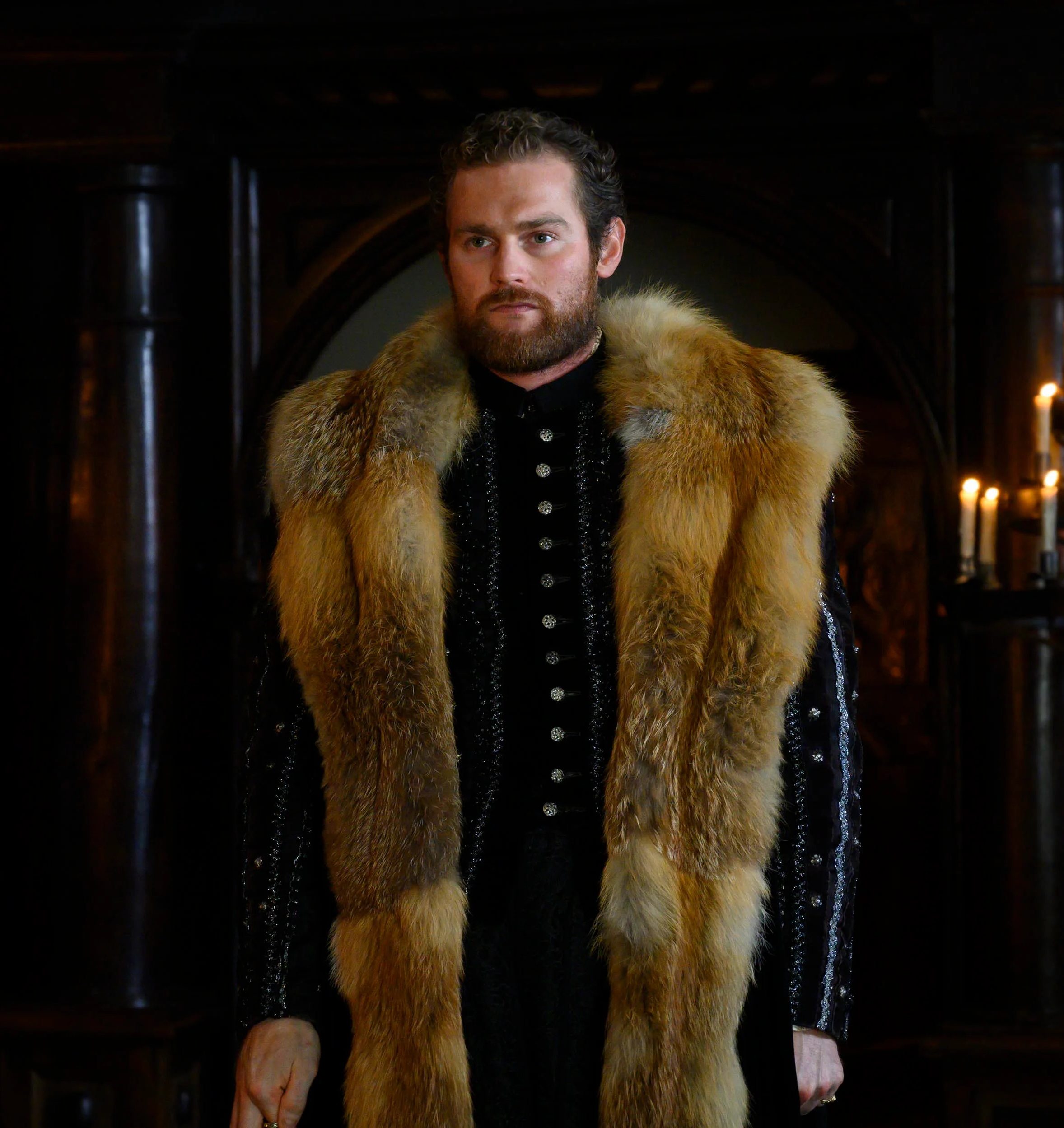
Those of you who were here for part three of my on-screen Anne Boleyn depictions ranking may remember that I placed this production’s Anne, Jodie Turner-Smith, as my third-favorite Anne actress on that list. Unfortunately, as with so many depictions of Henry and Anne’s relationship, Anne Boleyn (2021) balanced out a brilliant Anne portrayal with an uninspired, lifeless portrayal of Henry, one of England’s most fascinating and infamous kings, as a meek nonentity.
Henry only appears in two of the miniseries’ three episodes, with his last appearance in a heated argument with Anne the night before the May Day 1536 joust. You’d think that the writer of this show and Mark Stanley would’ve compensated for the king’s limited screen time by imbuing his appearances with a terrifying regal intensity and presence. After all, for Anne’s downfall to both make sense and have an emotional impact, it would be imperative that Henry’s character, both in writing and in performance, was a match for the powerhouse that is Turner-Smith’s Anne. Unfortunately, Mark Stanley’s Henry lacks energy or conviction in nearly every scene. Stanley can demonstrate Henry’s coldness towards Anne, yes, but he lacks authority and, for lack of a better word, the royal majesty one would expect from a king who’d broken with Rome and made himself Supreme Head of the Church of England. Even when Anne finds Jane Seymour sitting on Henry’s knee, all three characters are strangely inert. Turner-Smith’s Anne, at least, conveys a barely suppressed fury which soon boils over into distress and sorrow when she begins to miscarry, but Stanley’s Henry barely reacts! It’s as if he’s been told off by a teacher for clicking a pen too much.
It’s true that through quiet glances and nonverbal gestures, Stanley conveys the long history Henry’s had with Anne, particularly in episode two, when they have a conversation alone in the throne room. But even in that scene, Henry is far more weak-willed than the real king would have ever been; for one, Anne is shown sitting on the throne while Henry stands. It’s almost as if they’re trying to say that Anne held the real power in the relationship, as seen in how Stanley’s Henry tends to behave in a stereotypically submissive way in the bedroom. And yet, we all know that Anne ends up holding none of the levers of political power; her downfall at the hands of a cruel and misogynistic king and court is the whole premise of the show! It’s impossible to reconcile the vacant character of Stanley’s Henry with the king who is both universally feared and so furious and calculating as to order the execution of his wife and five other men on trumped-up charges, indirectly shown in episode three. Indeed, his last appearance (mentioned above) ends with him in tears after being bested in an argument by Anne. Would it have been so hard to show him actually enraged and scaring her? It’s infuriatingly inconsistent; Jodie Turner-Smith deserved a better-written, more formidable Henry with whom she could duel in their scenes.
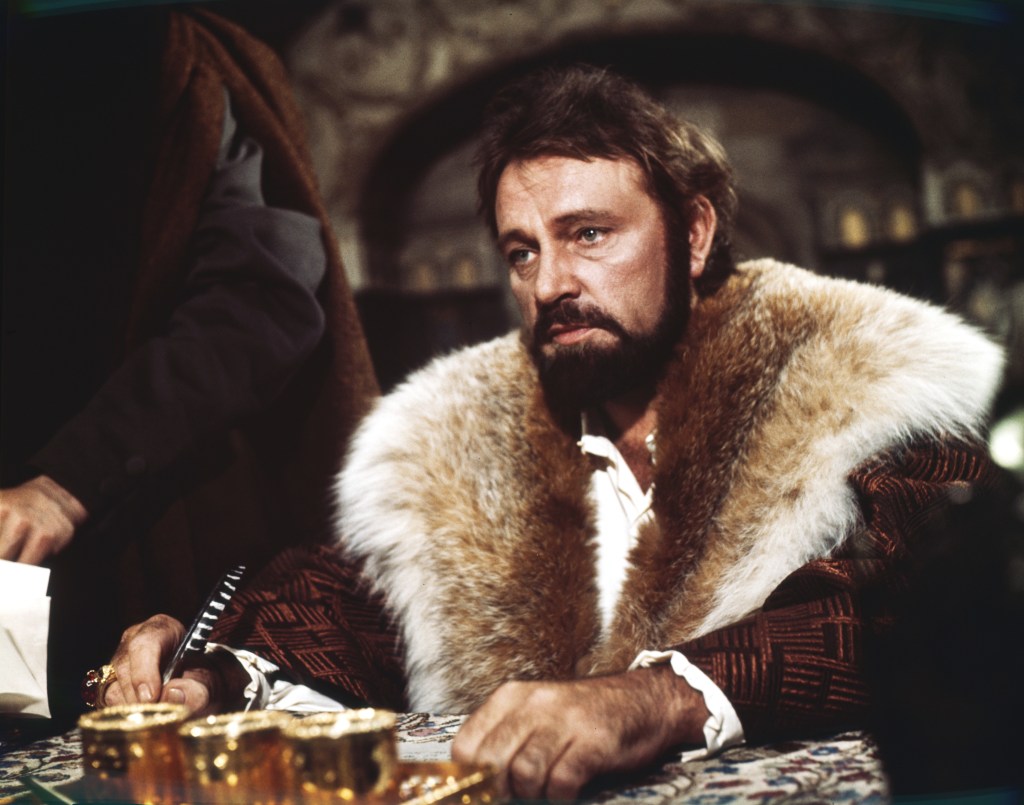
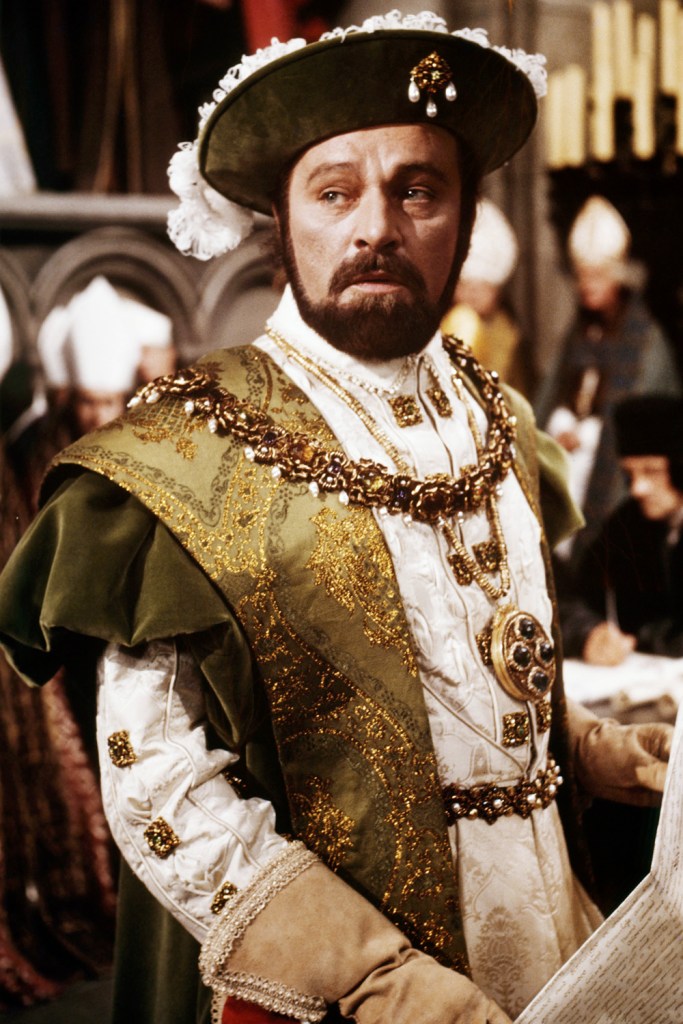
#7: Richard Burton in Anne of the Thousand Days (1969)
CW/TW: mentions and discussions of sexual harassment and domestic abuse
I’m not going to dwell on the fact that Burton, at 5’8, was far too short to convincingly radiate the imposing physical presence that the real Henry had in spades. What I will discuss is the fact that his depiction of Henry engages in all the lust and harassment of the real king and then more so, without any of the latter’s charm. One is left with the deeply disturbing, yet not quite accurate, depiction of Henry VIII as a king in the mold of a predatory 1960s Hollywood executive.
It is possible to portray Henry’s bonhomie and charisma as both superficially convincing, yet only superficially masking menace and edge just beneath the surface of the act he’s putting on for his courtly audience. Burton does not. From the first fifteen minutes of the movie, where Burton has to convince the audience that the king is the life of the party, Henry’s banter instead feels forced and unconvincing. Furthermore, when he later says to his courtiers that he’s never been “refused by a wench”, since “when I’ve wanted them, I’ve had them”, Henry is far too crudely and brutally carnal for the self-proclaimed romantic of history, who blushed when he overheard speech that was too bawdy. And this isn’t even getting into this Henry’s nonsensical appearance at Anne’s trial, acting as a prosecutor who exposes Mark Smeaton’s lies (albeit to no effect) and ahistorical argument with Anne in the Tower!
It is also incredibly difficult to understand why this Henry falls for Genevieve Bujold’s Anne. Fantastic and captivating though her performance is, between her and Burton, Bujold does most of the dramatic heavy lifting in this film. Burton’s Henry falls for Anne from the start of the narrative, with attempts at explanation only fitfully inserted at points after his infatuation is taken as a given. “I love your sweet voice, your company, and your bold spirit” — a real line in this movie — hardly counts as character building. More worryingly, this Henry’s lechery actually crosses into physical abuse. Henry backhands Anne at one point when she notes that any children they would have out of wedlock would be bastards, sending her flying across the room. As I said before, this is a deeply problematic trope. There’s no evidence that Henry ever physically abused any of his wives, except for the imprisonment and beheading of Anne Boleyn and Catherine Howard. Moreover, it is inconceivable that, had the real Anne behaved as rudely towards him as Bujold’s Anne often does, the real Henry’s fury and pride wouldn’t have then outweighed his lust and extinguished his attraction to her. When considering his avowed distaste for Bujold in his posthumously published diaries, I wonder whether Burton was even mentally present while filming this movie, or whether he was merely going through the motions of acting. His face is stuck between a scowl, a sneering smile, and a blank look, while his voice tends to vary between three registers: lecherous, bored, and angry. I’m only ranking him this high because at least, unlike Stanley’s Henry, Richard Burton gave his king some semblance of a forceful personality.
#6: Max Parker in Blood, Sex & Royalty (2021)
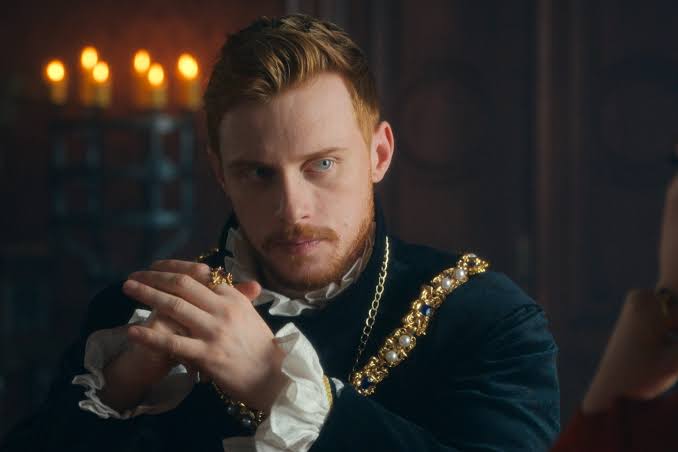
It’s been more than a year since I wrote about Amy James-Kelly’s depiction of Anne Boleyn in this production, and my thoughts on this three-parter have shifted somewhat. I still really dislike the terrible script. I think it aimed to be modern and relatable enough to attract a younger audience. However, in practice, lines like “The monasteries’ money will solve our little crop and famine crisis” proved singularly unsuccessful in convincing me that any of the actors were portraying Tudor royalty, nobility, or ministers. Unfortunately, Max Parker’s Henry is also affected by this lack of creative feeling for the sixteenth century.
I’m not denying the good sides to Parker’s depiction. He convincingly portrays the real Henry’s great passion for Anne, and he and Amy James-Kelly have nearly as much chemistry as I imagine the historical couple had. Moreover, by the end of the series, Parker’s chilling, ice-blue eyes even scared me to an extent, conveying some of the menace that the real Henry increasingly radiated as his reign progressed. He’s also great at portraying the real Henry’s charisma and sudden mood swings into jealous fury. However, it’s impossible to overlook the fact that Parker, who was 31 when this show aired, looks both far younger and far slimmer than the real Henry was in 1536, when Anne was executed. Indeed, no effort is made to age him with makeup or heavier clothing. Thus, I had the uncanny sensation of feeling like Anne’s rise and fall had somehow taken place both over the course of a decade, yet also in no time at all.
Above all, as with Mark Stanley’s Henry (above), Max Parker’s portrayal lacks the royal authority and gravitas that Henry had, as did nearly every other early modern monarch. Perhaps this is because of the writing, and the fact that both he and Amy James-Kelly seem resolutely determined to portray Henry and Anne as if they were soap opera characters, on a strangely small scale. I was never quite convinced that Parker’s Henry could command the respect, let alone the fear, of an entire kingdom, nor that he was a born royal who grew up thinking that he was only accountable to God (and usually had the latter on his side). In fact, despite his speech at a 1535 (ish?) feast midway through episode three, where he rails against the traitors and calls them “a plague among our people”, the only scene where he genuinely felt believable as a middle-aged, wife-hating tyrant was his last scene with Anne. Only then did Max Parker’s scary blue eyes successfully convey a man who’d already “lost the plot”, so to speak, in governance and his personal relationships. Unfortunately, this Henry’s lack of majesty, authority, or awe-inspiring terror outweighs the advantages listed above just enough to place Max Parker at the halfway point of this ranking.
#5: Ruairi O’Connor in The Spanish Princess (2019-2020)
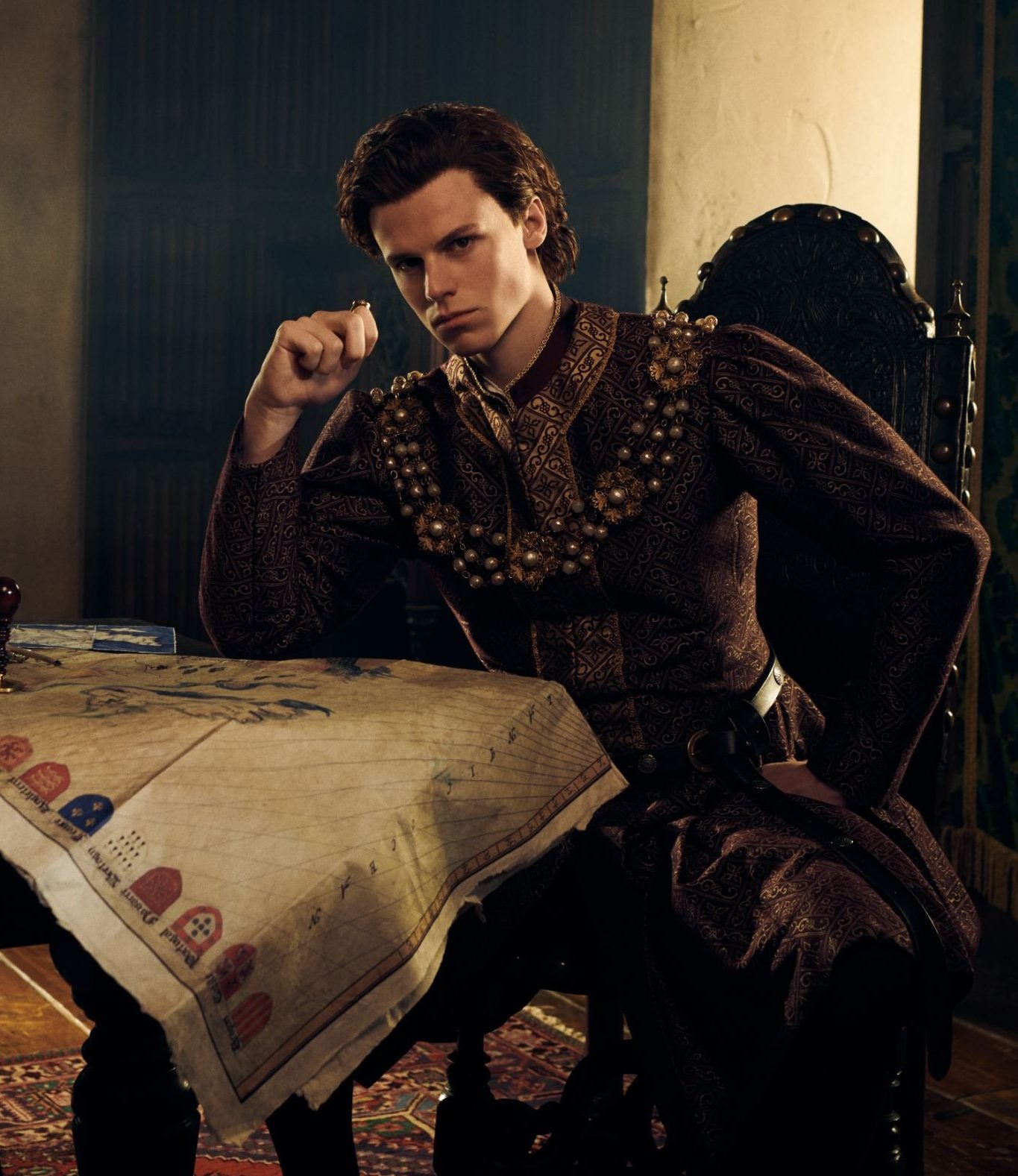
In conversations with my friends and family, I’ve often labeled The Spanish Princess as “the Tudor period drama equivalent of Riverdale”, another show with equally absurd and ludicrous plot points. One of these days, I’ll have to write my own review. Needless to say, it’s unsurprising that a show that made its version of Catherine of Aragon willingly leave court and not put up a fight against Henry’s quest for an annulment (!!!) was equally inaccurate in more ways than I can count throughout its two seasons. This basic failure to even respect the basic facts of history (e.g. Catherine fighting the annulment, loving her daughter Mary, etc), equally unsurprisingly, also bled into its portrayal of Henry.
For one, when Catherine of Aragon arrives in England to marry the then-Prince Henry’s older brother Arthur, Prince of Wales, she and Arthur are clearly older than their historical ages of 15. More worryingly, Henry has been aged up from 10 to at least 16, seemingly for the sole purpose of making him the real author of Arthur’s love letters to Catherine. In other words, Catherine has secretly been in love with Henry even before coming to England, something completely without foundation in either the Philippa Gregory novel on which the show was based or history. It’s gross to age up a historical child just so that you can make the main character have a romance with him far earlier than she did in history. Equally bizarrely, Henry is heavily implied to later on sleep with Catherine’s older sister, Juana of Castile, when the latter comes to England with her husband. Given that Henry was only 15 when this occurred, and that Juana’s stay at court was far shorter than the show depicts, this is similarly unlikely.
And yet, by the end of season one, Ruairi O’Connor does a good job of capturing the real Henry’s athleticism, vigor, and chivalric idealism as a young man. Credit must also be given to his chemistry with Charlotte Hope, Catherine’s actress (paralleled by their off-screen relationship). But even at the start of season two, when Henry’s only recently married Catherine, his rage when told that her father, Ferdinand of Aragon, has tricked him in his plans for a joint invasion is quite terrifying. In the end, though, these positives are outweighed by the negatives, and not only those listed above. O’Connor is great at depicting a young Henry, but as Henry ages and he grows harsher and more suspicious, he both overperforms and underperforms. He leans full throttle into the writers’ view of Henry as psychologically going off the rails even before he decides to abandon Catherine. However, even when Henry grows a beard and should be scarier, I actually found O’Connor less terrifying than earlier on, mainly due to his voice. Its tone fit a young king’s brash impetuosity, but I found it very unsuited for a more mature and despotic ruler; it sounded more cloying than awe-inspiring. So despite Henry’s portrayal being less egregiously inaccurate than Catherine’s, I can only rank this depiction at #5.
That’s it for now. As always, let me know your thoughts, whether you’ve seen these portrayals, and whether you agree with my ranking, in the comments below. Join me soon (I promise) for part 3: the good to superb portrayals of Henry VIII!
A little glimpse into a post I’m cooking up…
 Adventures in Early Modernity
Leave a comment